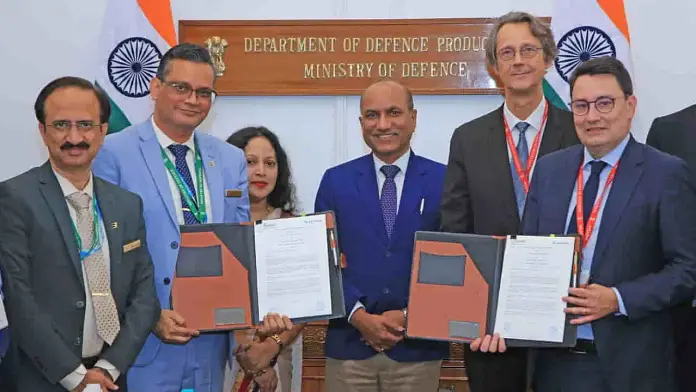
New Delhi — In a major boost to India’s self-reliance in defence manufacturing, Bharat Electronics Limited (BEL) and France’s Safran Electronics & Defence have signed a Joint Venture Cooperation Agreement (JVCA) to produce the HAMMER smart precision-guided air-to-ground weapon system within the country. The agreement was formalised in New Delhi on Monday, marking a significant milestone in the ‘Aatmanirbhar Bharat’ defence initiative.
Under the JV, a new private limited company will be established with an equal 50–50 partnership between BEL and Safran. BEL will oversee final assembly, quality checks and testing, while critical sub-assemblies, mechanical components and electronic systems will gradually be indigenised—reaching up to 60 percent local content. The production will be phased to support technology transfer to Indian industry, MSMEs and tech firms, opening fresh opportunities in the defence manufacturing ecosystem.
Top officials, including BEL CMD Manoj Jain, Safran Executive Vice President Alexandre Ziegler, Defence Production Secretary Sanjeev Kumar and Safran CEO Olivier Andriès, were present at the signing. BEL termed the collaboration a transformative step toward strengthening India’s airborne strike capabilities, while Safran reiterated its long-term commitment to co-development and technology transfer.
A Formidable Weapon for Rafale and Tejas
HAMMER—Highly Agile Modular Munition Extended Range—is a smart, precision-guided air-to-ground weapon capable of striking targets between 15 km and 70 km depending on launch altitude. Equipped with GPS and INS-based guidance, the weapon is known for its high accuracy, operating even in poor weather, night conditions and GPS-jammed environments. Variants with laser or infrared seekers can achieve accuracy within one metre.
The weapon’s modular structure converts standard bombs like MK-82 and BLU-111 into smart munitions. Mission payloads can be configured from 125 kg to 1,000 kg, with the 250-kg version widely used for anti-tank, bunker-buster and hardened-target missions. Once launched, the HAMMER travels at speeds close to Mach 0.9.

France has been using the HAMMER since 2007 across multiple operations in Libya, Afghanistan and Ukraine. In India, the system will significantly enhance the strike capability of Rafale fighters and the LCA Tejas once integration is complete. The Indian Air Force and Navy are both expected to benefit from indigenous production.
A Strategic Step in Indo-French Defence Ties
The JV builds on the MoU signed during Aero India 2025 and reflects strengthening strategic cooperation between India and France. With India seeking to reduce dependence on imported high-value weapons, domestic manufacturing will lower costs, ensure dependable supply and fortify readiness during emergencies.
Defence analysts say the HAMMER JV marks a major stride in developing India’s air-to-ground weapons ecosystem, aligning with national security priorities and long-term defence self-sufficiency.